
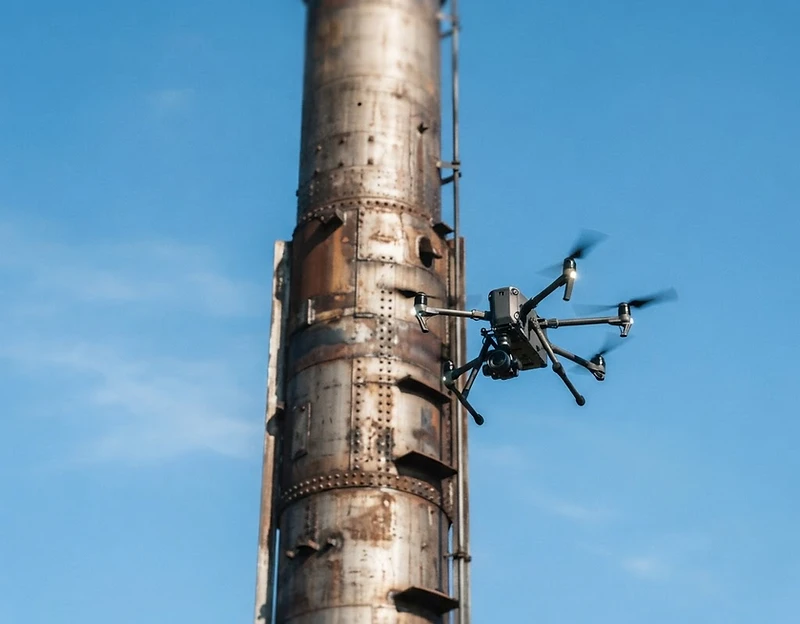
UAV Drone Inspection in Pasadena, TX
From TechCorr’s Pasadena headquarters, FAA-licensed pilots support inspections across the Houston Ship Channel, Texas refining corridor, and Gulf Coast. UAV visual examination adds a non-destructive testing (NDT) method for assessing elevated and confined assets while reducing the need for personnel access.
UAV Drone Inspection for the Gulf Coast
Pasadena’s industrial assets operate in a demanding environment: dense facilities, active process units, coastal weather, and equipment exposed to corrosion and wear. Across the Houston Ship Channel and Texas refining corridor, flare stacks, storage tanks, cooling towers, pipelines, and other structures may be difficult or hazardous to reach using conventional access methods. Inspection still needs to provide useful condition information without introducing unnecessary work-at-height exposure, confined-space entry, or scaffolding requirements.
UAV Drone Inspection helps plant managers and integrity engineers plan examinations around those constraints. An aerial or internal visual survey can document accessible surfaces and identify conditions that may warrant follow-up. It can support maintenance planning, outage preparation, and broader asset integrity programs, while fitting into the facility’s site access, safety, and inspection requirements. The drone does not replace every inspection method; it can help teams target conventional or advanced NDE where closer examination or additional data is needed.
A Non-Destructive Inspection Method
UAV Drone Inspection functions as a non-destructive testing and inspection method through remote visual examination. A remotely operated aircraft or vehicle carries a camera into or around an asset, allowing a qualified team to observe and document visible conditions without cutting, damaging, or altering the component. In this application, NDT and NDE refer to examination approaches used to evaluate materials and equipment without impairing their intended serviceability; drone imagery provides visual evidence, not a direct measurement of hidden flaws or remaining wall thickness.
TechCorr’s FAA-licensed commercial drone operations support in-service and out-of-service visual examinations. Internal drone flights may be used to survey storage tanks, pressure vessels, and suitable confined spaces, potentially reducing the need for personnel entry or extensive temporary access. External flights can examine accessible areas of flare stacks, smokestacks, cooling towers, and elevated structures. Where underwater conditions are involved, remotely operated vehicle (ROV) inspection may support visual examination of subsea pipelines, risers, and offshore structures, subject to project scope and operating conditions.
The inspection plan should define the target areas, access limitations, deliverables, and any follow-up required. Image quality, lighting, distance, surface condition, and flight constraints can affect what is visible. Findings are interpreted within those limits and coordinated with the applicable inspection program. If visual evidence indicates a concern that requires characterization beyond surface observation, TechCorr can help align additional NDT or NDE methods with the asset and examination objective.
What TechCorr’s Pasadena Team Delivers
TechCorr’s Pasadena headquarters anchors Gulf Coast operations, with rapid-response radiographic testing callouts, storage tank inspection, conventional NDE, advanced NDE, and full asset integrity management available through the flagship office. That local capability gives plant teams a point of coordination for UAV inspection and related examination needs across Pasadena, the Ship Channel, and the wider refining corridor. TechCorr can also mobilize services nationwide from Pasadena.
Each project is scoped around the asset, operating status, inspection objective, and site requirements. The team coordinates the appropriate drone platform and visual coverage, considers whether an internal or external approach is practical, and documents observed conditions for review. Where the scope calls for it, UAV findings can inform follow-on tank inspection, radiographic testing, or other conventional and advanced NDE work. This connection between field observations and complementary methods helps integrity teams put inspection data into context rather than treating imagery as a stand-alone answer.
UAV work remains subject to applicable aviation rules, facility procedures, airspace conditions, and safe operating limits. Asset owners should establish the necessary permits and operational controls, communicate hazards, and confirm that the selected method is suitable for the requested examination. TechCorr can coordinate project planning with the facility team to clarify responsibilities, access, and reporting expectations before mobilization.
Standards, Qualifications, and Inspection Planning
Inspection requirements depend on the asset type, governing code, owner-user practices, and the purpose of the examination. API 510 addresses pressure-vessel inspection, repair, alteration, and rerating; API 570 applies to in-service piping systems; and API 653 covers aboveground storage tank inspection, repair, alteration, and reconstruction. A drone visual survey may contribute observations to an inspection plan, but it does not by itself establish compliance with these codes or replace required inspection activities. The responsible inspector and asset owner determine how results are used.
Personnel qualifications and written procedures should also match the work. ASNT practices and applicable certification requirements can inform the qualification of NDT personnel and oversight of examination activities. NACE International, now AMPP, standards and guidance may be relevant when assessing corrosion, coatings, or corrosion-control concerns. ISO standards may apply to quality management, inspection processes, or other project requirements. The specific editions, qualifications, procedures, and acceptance criteria should be agreed upon for each job; they should not be assumed from the use of a drone alone.
A clear scope identifies the asset and areas of interest, operating condition, visual objectives, access restrictions, documentation needs, and decision points for escalation. This makes UAV inspection more useful within a facility’s asset integrity strategy and helps distinguish observable surface conditions from questions that require other NDE methods.
Why TechCorr Pasadena
TechCorr combines local Gulf Coast mobilization with the broader NDT depth of its Pasadena flagship office. Plant managers and integrity engineers can coordinate UAV visual examination alongside radiographic testing, storage tank inspection, conventional and advanced NDE, and asset integrity management—all through one service partner. The result is a practical path from remote visual observations to appropriately scoped follow-up, without overstating what drone imagery can determine.
Contact TechCorr to discuss a UAV Drone Inspection in Pasadena, TX. Share the asset type, inspection objective, operating status, and access constraints, and the team can help evaluate a suitable scope and coordinate next steps for your facility.
Why Pasadena Chooses TechCorr for UAV Drone Inspection
- Pasadena-based dispatch for Houston Ship Channel and Gulf Coast assets
- UAV visual inspection backed by conventional and advanced NDE depth
- Radiographic testing and storage tank inspection coordinated locally
- Asset integrity support from TechCorr’s flagship Gulf Coast office
UAV Drone Inspection in Other Cities
Your Local Office
1485 E Sam Houston Pkwy S, Ste 160, Pasadena, TX 77503
713-524-2768