
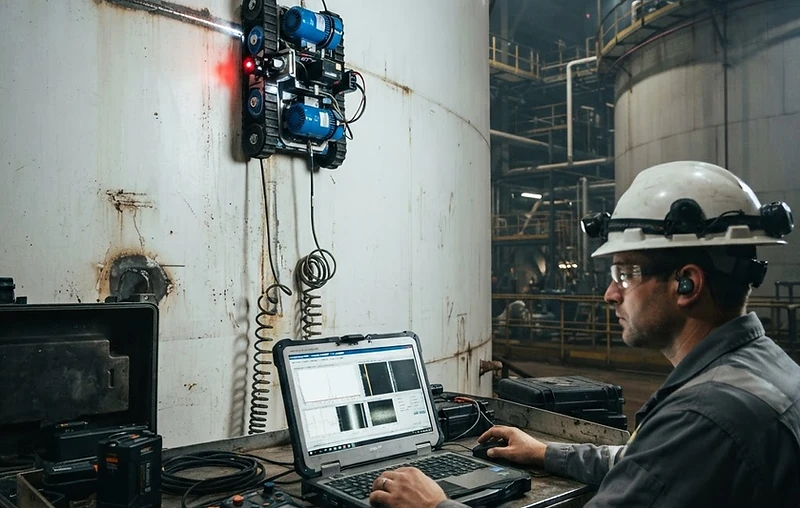
Robotic Crawler Inspection
Robotic crawler inspection for storage tanks, vessels, and pipelines — UT thickness, visual, and TOFD/PAUT data collected autonomously by TechCorr.
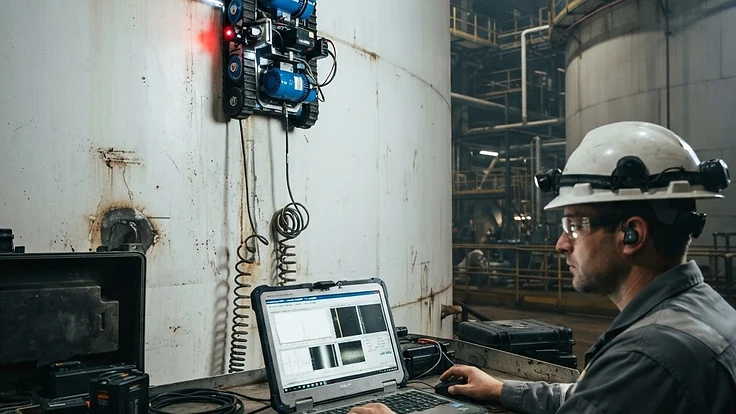
Robotic crawler inspection brings autonomous data collection to the floor and shell of storage tanks, the interior of vessels, and the length of pipelines. TechCorr deploys magnetic-tracked and tethered crawlers fitted with ultrasonic thickness, visual, and advanced ultrasonic (PAUT/TOFD) sensors to collect dense, repeatable measurements without confined-space entry or scaffolding where conditions allow.
Applications
- Storage tank floors and shells — automated floor-mapping UT for API 653 compliance without full entry.
- Pressure vessels and columns — internal visual and UT inspection of in-service or out-of-service vessels.
- Pipelines — long-range and robotic in-line inspection for wall loss, cracking, and laminations.
- Confined and hazardous spaces — inspection in spaces where human entry is restricted.
The Advantage
- Dense, repeatable data: consistent coverage and positioning makes the data ideal for predictive trending inspection-over-inspection.
- Reduced entry risk: crawlers reduce confined-space and at-height entries.
- Faster turnaround data: robotic collection shortens the inspection window on turnarounds.
Standards
API 653 (storage tanks), API 510 (pressure vessels), API 570 (piping), and ASME Section V — with crawlers complementing, not replacing, certified Level II/III technicians who interpret the data.
Robotic Crawler Inspection Available Near You
TechCorr mobilizes certified crews from 14 offices across North America — every service is available everywhere, with rapid regional response from the office nearest your site.